
Russia Northern Lights: Where and When to See the Aurora
Travellers researching russia northern lights trips often imagine green waves moving above snowy forests, frozen lakes, and Arctic tundra. Russia offers vast northern territories where the aurora can be observed, but Murmansk and the surrounding Kola Peninsula remain among the most accessible destinations for a dedicated Northern Lights journey.
Seeing the aurora is never as simple as arriving at a famous viewpoint. The display depends on darkness, geomagnetic activity, cloud cover, and local weather. A successful trip therefore requires flexibility, realistic expectations, warm clothing, and enough time to wait for suitable conditions.
Where Can You See the Northern Lights in Russia?
The aurora is most commonly observed in northern regions situated within or close to the auroral oval. These areas include the Kola Peninsula, Karelia, the Arkhangelsk region, northern Siberia, and parts of the Russian Far East.
However, not every northern destination is equally convenient for travellers. Some areas are extremely remote, require complex transport arrangements, or have limited tourist infrastructure.
Murmansk is a practical choice because it combines:
- a location above the Arctic Circle;
- relatively easy access;
- accommodation and city infrastructure;
- nearby areas with little artificial light;
- open tundra and wide horizons;
- opportunities for private and group aurora tours;
- additional Arctic excursions during the day.
Visitors can stay in Murmansk and travel into the countryside when forecasts indicate promising conditions.
Why Murmansk Is a Popular Aurora Destination
Murmansk lies in a favourable geographical position for Northern Lights observation. The city itself is surrounded by sparsely populated landscapes where light pollution decreases rapidly.
The nearby countryside includes tundra, forests, frozen lakes, low hills, and open valleys. These locations provide attractive foregrounds for photography and allow travellers to observe a large part of the sky.
Another advantage is mobility. If one direction is cloudy, it may be possible to drive towards a clearer area. This is important because cloud cover often determines the result of an aurora hunt more than a single geomagnetic index.
When Is the Best Time to See the Northern Lights in Russia?
The main viewing season in the Murmansk region generally lasts from late August until early or mid-April.
During summer, the Northern Lights may still occur in the atmosphere, but they are hidden by the midnight sun and bright Arctic nights.
September and October
Early autumn offers relatively mild temperatures and unfrozen lakes. On calm nights, the aurora may be reflected in the water.
The tundra also becomes red, orange, and golden, making this season attractive for landscape photography. The main disadvantage is unstable weather and frequent cloud cover.
November to January
Winter brings long nights, snowy scenery, and many hours of darkness. These conditions create the classic Arctic atmosphere associated with Northern Lights travel.
Visitors should be prepared for:
- low temperatures;
- strong winds;
- icy roads;
- snowstorms;
- rapidly changing visibility.
Warm clothing becomes essential because aurora observation often involves standing still outdoors.
February and March
Late winter is convenient for travellers who want to combine aurora hunting with daytime excursions. The days become longer, but the nights remain dark enough for observation.
This period is suitable for visiting Murmansk, Teriberka, Kirovsk, or the Khibiny Mountains while reserving one or more evenings for the aurora.
Early April
Northern Lights displays remain possible in early April. However, darkness arrives later and the available viewing window becomes shorter as spring progresses.
What Conditions Are Needed to See the Aurora?
Several factors must come together.
Darkness
The sky must be sufficiently dark. Strong city lighting reduces contrast and can hide weaker displays.
Clear Skies
Clouds can completely block the aurora, even when geomagnetic activity is high. Finding clear weather is often the most important part of the search.
Geomagnetic Activity
Solar wind and disturbances in the Earth’s magnetic field create the aurora. Forecasts can estimate probability, but they cannot guarantee a particular result.
A Suitable Observation Area
The best locations offer dark skies, safe road access, an open horizon, and enough space to stop without disturbing traffic.
What Is an Aurora Hunt?
An aurora hunt is a mobile evening or night journey rather than a visit to one permanent viewing platform.
Before departure, the route is selected according to:
- low, middle, and high cloud cover;
- wind direction;
- movement of weather fronts;
- solar wind conditions;
- geomagnetic forecasts;
- road safety;
- artificial light pollution;
- access to observation points.
The chosen direction may change during the trip. If clouds move over the first location, the group may continue towards another area.
This flexibility is one of the main advantages of an organised Northern Lights tour.
How a Northern Lights Tour Usually Works
A typical journey begins after the sky becomes dark enough.
The programme may include:
- Checking updated weather and aurora forecasts.
- Collecting participants in Murmansk.
- Driving outside the city.
- Stopping at an open, dark location.
- Assessing the actual cloud cover.
- Moving to another area if necessary.
- Waiting for auroral activity.
- Taking photographs.
- Returning to the city.
Sometimes the Northern Lights appear quickly. On other nights, travellers may wait for several hours or visit multiple locations.
For this reason, the exact return time is difficult to predict. It is sensible to avoid an early flight or a demanding excursion the following morning.
Can the Northern Lights Be Guaranteed?
No. The aurora is a natural phenomenon and cannot be guaranteed by any tour, hotel, driver, or forecast.
A well-organised trip can improve the chances by:
- choosing a promising night;
- comparing several forecasts;
- searching for clear skies;
- avoiding city light pollution;
- changing locations;
- waiting for activity to increase.
Even so, the sky may become cloudy or the geomagnetic forecast may not develop as expected.
Travellers should be cautious about any offer promising a guaranteed bright display. Organisation, transport, and route planning can be guaranteed; the aurora cannot.
What Does the Northern Lights Look Like in Reality?
The aurora varies greatly in brightness and structure.
A weak display may resemble a pale cloud or a greyish arc. A camera may show its green colour before it becomes obvious to the human eye.
A moderate aurora can form:
- green arcs;
- vertical rays;
- slow-moving bands;
- bright areas above the horizon.
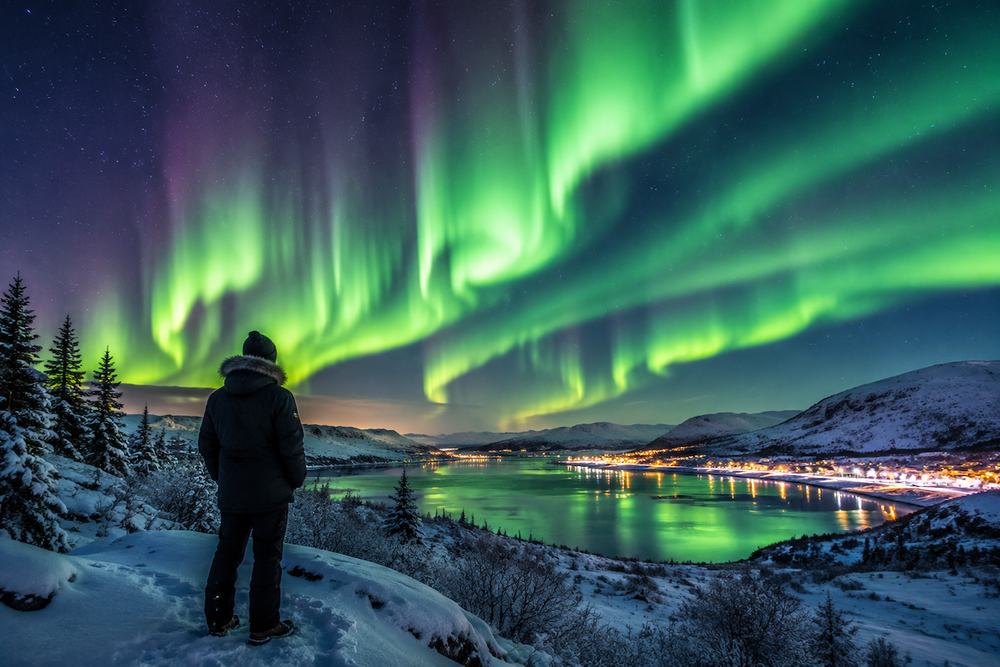
During stronger activity, the sky may fill with moving curtains, pillars, waves, and a corona directly overhead. Green is the most common colour, while purple, pink, and red shades occasionally appear.
Photographs often look brighter because cameras collect light over several seconds. Strong displays, however, can be clearly visible without any equipment.
Best Places Near Murmansk
There is no location that works every night. The best place is usually the clearest accessible area with minimal artificial lighting.
Possible settings include:
- open tundra;
- frozen lakes;
- countryside roads;
- forest edges;
- valleys;
- low hills;
- areas outside small settlements.
Popular viewpoints are not always ideal. Large numbers of vehicles, headlights, and flashlights can make photography difficult.
A quieter location with a clear sky may be better than a famous place covered by clouds.
Northern Lights in Teriberka
Teriberka is known for its Barents Sea coastline, rocky landscapes, and low levels of light pollution. An aurora above the sea can create spectacular photographs.
However, coastal weather is highly variable. Fog and low clouds may remain above Teriberka while inland areas are clear.
Travellers staying overnight in the village may have an opportunity to see the aurora. For a dedicated hunt from Murmansk, flexibility is often more valuable than travelling to one predetermined destination.
Northern Lights in Kirovsk and the Khibiny Mountains
The Khibiny Mountains provide dramatic winter scenery, including snow-covered slopes, valleys, and frozen lakes.
At the same time, mountains influence local weather. Clouds may remain close to the slopes, and the terrain can block parts of the horizon.
Kirovsk is an attractive option for travellers already staying in the area, but conditions should always be checked before planning a special journey from Murmansk.
Individual and Group Tours
Northern Lights tours are available in two main formats.
Group Tours
Group tours are usually priced per person and may be more economical for solo travellers.
Possible disadvantages include:
- waiting for other passengers;
- limited flexibility;
- less personal space;
- a shared pace;
- less time for individual photographs;
- difficulty returning early.
Individual Tours
A private trip is arranged for one traveller, a couple, a family, or a small party.
Its advantages include:
- no strangers in the vehicle;
- flexible stops;
- greater route freedom;
- more photography assistance;
- a programme adapted for children;
- the possibility of an earlier return;
- a quieter travel experience.
For a family or small group, the cost of a private vehicle may be comparable to purchasing several places on a group tour.
How to Photograph the Aurora with a Smartphone
Modern smartphones can capture good Northern Lights photographs, particularly when they offer night mode.
For better results:
- clean the camera lens;
- switch off the flash;
- activate night mode;
- use a tripod;
- keep the phone still during exposure;
- avoid digital zoom;
- include a person or landscape feature in the foreground.
Cold weather reduces battery life. Keep the phone and power bank inside your jacket when they are not being used.
What to Wear
Aurora hunting involves standing outdoors with little movement, so the body cools quickly.
Winter clothing should include:
- thermal underwear;
- a fleece or wool layer;
- an insulated jacket;
- warm trousers;
- winter boots with thick soles;
- wool socks;
- a hat;
- a scarf or neck warmer;
- insulated mittens.
Thin gloves are useful for camera controls, but warm mittens should be worn over them between photographs.
Windproof clothing is also important in autumn and spring.
What to Bring
Useful items include:
- a fully charged smartphone;
- a power bank;
- a small tripod;
- spare camera batteries;
- a hot drink;
- a light snack;
- personal medication;
- hand warmers;
- a lens cloth;
- motion sickness medication if needed.
Bright flashlights should be avoided unless necessary. They affect night vision and may spoil photographs.
How Many Nights Should You Plan?
A single-night trip carries a significant risk. Even strong geomagnetic activity cannot be seen through dense clouds.
Spending several days in the Murmansk region gives travellers more opportunities to choose a suitable evening.
A practical itinerary may include:
- a Murmansk city tour;
- a day trip to Teriberka;
- a visit to the Khibiny Mountains;
- one main aurora night;
- one backup evening.
The final date can then be selected according to the latest weather forecast.
Common Mistakes
One of the most common mistakes is relying on a single aurora index while ignoring cloud cover.
Other mistakes include:
- booking only one possible night;
- wearing ordinary city clothing;
- expecting a guaranteed display;
- choosing a tour only by price;
- leaving immediately after the aurora fades;
- using bright lights;
- expecting every display to match edited photographs;
- assuming one location is always best.
Auroral activity often occurs in waves. A weak display may disappear and return later with greater intensity.
How to Choose a Tour
Before booking, ask about:
- group size;
- vehicle type;
- departure point;
- expected duration;
- route flexibility;
- photography assistance;
- child seats;
- bad-weather policies;
- rescheduling conditions;
- services included in the price.
A genuine aurora hunt should allow the route to change. A fixed transfer to one location offers less flexibility when the weather changes.
Frequently Asked Questions
Where is the best place to see the Northern Lights in Russia?
Northern regions offer many possibilities, but Murmansk is one of the most accessible destinations with developed infrastructure and nearby dark-sky areas.
When should I travel?
The main season runs from late August to early April. Winter provides long nights and snowy landscapes, while autumn offers milder temperatures.
How long does an aurora tour last?
Most tours last several hours. Duration depends on weather, distance, and the time at which activity begins.
Do I need a professional camera?
No. A modern smartphone with night mode and a tripod is usually sufficient.
Can children join?
Yes, provided they can manage a late night, cold weather, and possible long periods in the vehicle.
Is the aurora visible every clear night?
No. Clear skies are essential, but sufficient geomagnetic activity is also required.
Why See the Northern Lights in Russia?
A Northern Lights journey is more than a photograph. It includes travelling through the Arctic night, searching for clear skies, waiting in the silence of the tundra, and watching the horizon for the first pale glow.
The display may begin as a quiet arc and gradually develop into moving green curtains stretching across the sky. It may last only a few minutes or return several times during the night.
Every aurora is different. That unpredictability makes seeing the Northern Lights in Russia one of the most memorable experiences of an Arctic journey https://murmansk-northern-lights.com/.