
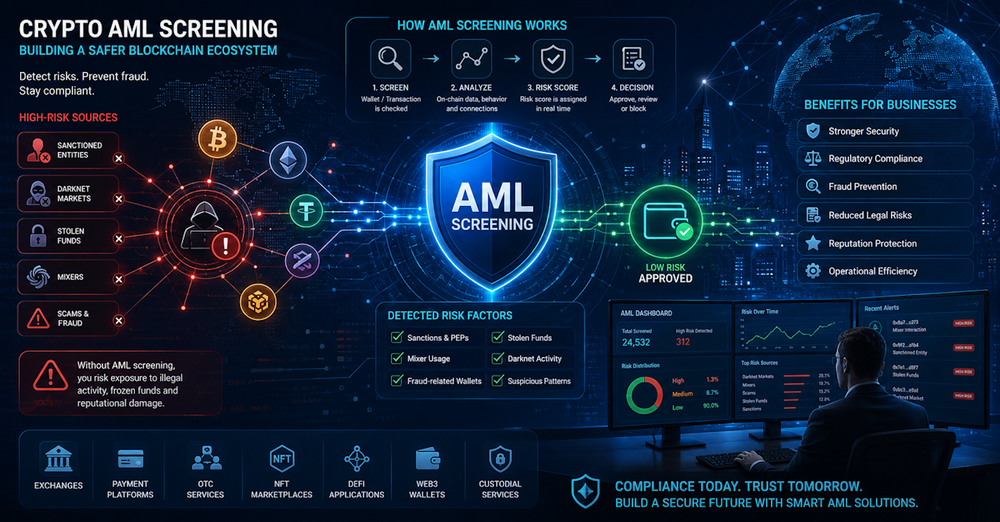
As the cryptocurrency industry continues to grow, businesses and individual users face increasing risks related to fraud, money laundering, scams, and illegal transactions. Digital assets move quickly across multiple blockchains, making it difficult to track the origin of funds without specialized tools. This is why crypto AML screening has become an essential part of modern blockchain infrastructure and compliance systems.
Crypto AML screening helps identify suspicious wallet activity, detect high-risk transactions, and reduce exposure to illegal financial operations. Today, exchanges, payment providers, fintech companies, and Web3 platforms rely on AML solutions to improve security and protect users from compliance risks.
What is crypto AML screening?
AML stands for Anti-Money Laundering. In the cryptocurrency industry, AML screening refers to the process of analyzing blockchain transactions and wallet addresses in order to identify connections with risky or illegal activity.
Specialized blockchain analytics systems evaluate transaction history, wallet behavior, and on-chain relationships to determine whether funds may be linked to darknet markets, stolen assets, scams, sanctioned entities, mixers, or other suspicious sources.
Unlike traditional banking systems, blockchain transactions are transparent and publicly visible. However, because crypto wallets are pseudonymous, identifying real risks requires advanced analytics and monitoring technologies.
Why AML screening matters in crypto
The cryptocurrency ecosystem operates globally and often without intermediaries. While this creates flexibility and innovation, it also increases the risk of financial abuse. Businesses that accept or process cryptocurrency may unknowingly interact with wallets connected to illegal activities.
Without AML screening, companies can face serious consequences, including frozen funds, blocked withdrawals, reputational damage, and regulatory problems. Even regular users may accidentally receive “tainted” crypto from suspicious wallets.
AML monitoring is especially important for:
- crypto exchanges;
- payment platforms;
- OTC services;
- NFT marketplaces;
- DeFi applications;
- Web3 wallets and custodial services.
How crypto AML screening works
Modern AML systems analyze blockchain data in real time. When a wallet address or transaction is checked, the platform assigns a risk score based on transaction history and exposure to suspicious sources.
Advanced AML tools can detect:
- connections with sanctioned entities;
- mixer usage;
- fraud-related wallets;
- stolen funds;
- darknet activity;
- suspicious transaction patterns.
Many businesses integrate automated AML APIs directly into their infrastructure to screen transactions before processing deposits or withdrawals.
For example, the Crypto Chief platform offers the AML Intelligence solution for blockchain risk analysis, crypto wallet screening, transaction monitoring, and on-chain tracing. Such tools help companies identify threats faster and improve compliance processes without slowing down their services.
Benefits of AML screening for businesses
As crypto adoption increases, regulatory expectations also continue to grow. AML screening is no longer optional for many companies operating in the digital asset industry.
The main advantages of AML monitoring include improved transaction security, reduced legal risks, stronger fraud prevention, and better reputation management. Businesses that implement blockchain compliance tools can detect suspicious behavior earlier and avoid interactions with high-risk wallets.
AML systems also help automate compliance workflows, which is especially important for companies handling large transaction volumes across multiple blockchains.
The future of blockchain compliance
The crypto industry is moving toward greater transparency and regulatory maturity. Governments and financial regulators worldwide are introducing stricter requirements for cryptocurrency businesses, especially regarding transaction monitoring and risk assessment.
As a result, blockchain analytics and AML technologies will continue evolving rapidly. Artificial intelligence, machine learning, and real-time blockchain monitoring are already improving the accuracy of crypto risk detection systems.
Companies that invest in AML infrastructure today are better prepared for the future of Web3 compliance and digital asset security.